
Externships help you develop your practical skills in a professional setting while building relationships in the legal community. Working in a government or non-profit organization under the supervision of an attorney, you will experience what the day-to-day work of being a lawyer entails. There are numerous externship opportunities in the Baltimore area, but Baltimore’s convenient location on the east coast gives you access to positions along the I-95 corridor, from New York City to Washington, D.C., and beyond.
Externships may align directly with your career goals or provide the opportunity to explore an area of the law you may not have previously considered. If you are interested in getting a first-hand look at the inner workings of Congress, our Legislative/Congressional Externship Program offers an immersive experience on Capitol Hill. Similarly, our Asper Judicial Externship Program will help you understand the practical workings of the legal system through state and federal courts.
When you enroll in an externship, you are also required to enroll in a corresponding one credit workshop where you will discuss your experience with other students and a faculty supervisor. While workshop content will vary based on the supervisor, activities may include readings relating to the substance of the work you are doing, reflective memos about your experience, discussions on meeting expectations and diversity in the workplace, and more. This guided reflection will help you get the most out of your externship experience.
Approved by the Faculty Council on May 4, 2017; Amended May 4, 2023
Policy Statement on Externships
The following statement applies to all of the externships offered for credit at the University of Maryland Carey School of Law ("School"). Any student interested in enrolling for academic credit in an externship should read this statement of policy in its entirety prior to application.
Summary of ABA Standard 304
The ABA permits law schools to grant credits toward the J.D. degree for courses or a program that requires student participation in studies or other activities outside the school. Credits are to be commensurate with the time and effort required of the student and the anticipated quality of the educational experience. "Faculty members," defined to include full or part-time teachers at the sponsoring school or another accredited law school, must supervise each student's experience. All such offerings must be approved in advance and reviewed periodically.
All field placements must provide substantial lawyering experience that (1) is reasonably similar to the experience of a lawyer advising or representing a client or engaging in other lawyering tasks in a setting outside a law clinic under the supervision of a licensed attorney or an individual otherwise qualified to supervise, and (2) includes the following:
- (i) a written understanding among the student, faculty member, and a person in authority at the field placement that describes both (A) the substantial lawyering experience and opportunities for performance, feedback and self-evaluation; and (B) the respective roles of faculty and any site supervisor in supervising the student and in assuring the educational quality of the experience for the student, including a clearly articulated method of evaluating the student’s academic performance;
- (ii) a method for selecting, training, evaluating and communicating with site supervisors, including regular contact between the faculty and site supervisors through in-person visits or other methods of communication that will assure the quality of the student educational experience.
- (iii) evaluation of each student’s educational achievement by a faculty member; and
- (iv) sufficient control of the student experience to ensure that the requirements of the Standard are met
The ABA standard limits participation in field placements to students who have successfully completed sufficient prerequisites or shall receive sufficient contemporaneous training to assure the quality of the student educational experience.
Definitions
For purposes of this policy, the School adopts the following definitions.
"Faculty member" means full-time and part-time faculty, including adjunct professors and decanal academic appointments.
"Periodic site visit or their equivalent" means an opportunity for a student, a supervising attorney, and a faculty member to converse, one-on-one, for an adequate period of time, about the student's experience with and performance during the externship.
“Guided reflection" means having meetings at least once every two weeks in the form of a workshop with other students enrolled in externships and a faculty member to discuss the development of skills needed to achieve excellent performance during an externship, substantive law involved in an externship, or critical evaluation of the institutional, professional, and ethical challenges faced by attorneys involved in the externship or similar work. In exceptional circumstances, when a workshop is not practical and upon the approval of the Associate Dean for Academic Affairs, guided reflection may include one-on-one tutorials between the student and a faculty member. All such guided reflection shall occur during a period contemporaneous with the externship.
Ground Rules for Externships
Externships provide students with exceptional opportunities to learn about law practice. They should not duplicate opportunities already provided by the school in other areas of the curriculum.
To ensure compliance with the Fair Labor Standards Act (FLSA), the School does not sponsor externships with for-profit institutions such as law firms. In extraordinary circumstances, the Associate Dean for Academic Affairs may approve an externship at a for-profit institution when the work experience provided would be unique and the student and their faculty adviser can demonstrate in writing that compliance with FLSA will be accomplished.
Externships may last for one or two semesters, with a maximum credit allocation of 11 credits at one institution. Students seeking to enroll in an externship during the same semester as a clinic must have the approval of both the clinic professor and the field supervisor.
In general, students should not apply for an externship with an organization where the student has previously worked. In exceptional cases, students may receive approval to extern at an institution where they have worked if the externship involves legal work and their other work for the institution was in a different professional capacity (e.g., a nurse who will take an externship placement in the hospital general counsel's office). Students applying for a placement with an institution where they have already worked should provide an explanation of how the new externship will enhance their education.
The externship experience should engage the student in more than library research and memo drafting and instead should involve a wide range of legal work in a high quality and well-supervised professional setting. Educationally valuable activities include: accompanying and assisting an attorney supervisor as they meet with clients; legal research and writing; evaluating claims; taking depositions; conducting negotiations; participating in administrative hearings, and arbitration or mediation proceedings; attending court proceedings; and drafting legislation, regulations or contracts. An externship should enable a student to enhance his or her writing skills.
Remote Externships
In-person, on-site externships are preferred so students receive adequate supervision and mentorship and can learn from meaningful interactions with other attorneys, judges, or professionals. Nevertheless, students may request approval for a remote externship in the following limited circumstances:
- The placement worksite is operating completely remotely and there is no opportunity for the student to engage in in-person work; or
- The externship is not local and presents a unique educational experience that is not otherwise available to the student in this region (Maryland, Washington, DC, and surrounding states).
For remote externships to be approved, attorney supervisors must agree to integrate remote students into the work of the office on a regular basis and must provide adequate supervision and meet with the remote students at least once per week, either remotely or in person. Remote externships must satisfy all other externship requirements.
Students participating in remote externships must attend the externship workshop in-person at the law school.
Externship Opportunities
The School offers externships at governmental and not-for-profit organizations in the following categories:
- Alternative Dispute Resolution
- Business Law
- Criminal Law
- Environmental Law
- Health Law
- Homeland Security
- Intellectual Property Law
- International Law (including South Africa)
- Judicial (Asper Fellowships)
- Legislative (federal and Maryland) Public Interest
Examples of specific externship opportunities appear on the School's Externships
page and on specialty program pages. For further information about externship
opportunities, students should make appointments with the person identified on the website as responsible for a specific area well before the semester in which the student hopes to enroll for that experience.
Regardless of the area of their interest, any student seeking an externship shall apply using the standard application posted at the same location on the School's website, following the instructions for submitting the form, including the relevant deadline. Students should not wait until the sponsoring organization has approved the externship if any such delay will cause them to miss the deadline. Students should only apply if they have a serious interest in following through on the externship, but of course are not bound to assume externship responsibilities if the sponsoring organization fails to approve the placement in a timely manner.
Prerequisites, Credits, and Evaluation
- Externships are open to students who have completed the standard “first year” curriculum for day students and the standard “first- and second-year curriculum” for evening students.
- Students cannot earn more than 20 credits in courses without regularly scheduled class sessions which includes externships.
- Externships are graded on a credit/no credit basis.
- The number of credits available varies from three to eleven, depending upon the nature of the work and the number of hours devoted to it.
- The maximum number of credits is for an educationally rich, full semester externship with a workload of at least forty hours per week. Students should expect to work four hours/week for each credit earned in an externship. For example, a four-credit externship should involve 16 hours of weekly work. 1 credit = 48 hours.
-
Externship Hours Needed By Credit Amount
#Credits 2 3 4 5 6 7 8 9 10 11 Total Hours To Be Worked 96 144 192 240 288 336 384 432 480 528 -
Externship Hours Needed Per Week By Credit Amount
#Credits 2 3 4 5 6 7 8 9 10 11 FALL/SPRING (12 WEEKS) 8 12 16 20 24 28 32 36 40 44 SUMMER (8 WEEKS) - 18 24 30 36 - - - - - SUMMER (9 WEEKS) - 16 21.3 26.7 32 37.3 - - - - SUMMER (10 WEEKS) - 14.4 19.2 24 28.8 33.6 38.4 - - -
-
- Academic credit will not be awarded for any externship until all required reports have been submitted, including reports from the student, the faculty supervisor, and the supervising attorney at the organization sponsoring the externship.
Role of the Faculty Supervisor
Through this experience and exposure, the student should develop insights into the applied knowledge, skills, and ethical standards that are required for successful practice, as well as the overall strengths and weaknesses of the legal system. To help the student develop those insights, externships must be linked, in the same semester, to a workshop, or, in rare cases, when a workshop is impractical, a tutorial that provides "guided reflection" (see definition, above) with a faculty member. In general, a workshop shall carry one additional academic credit, although students may audit the workshop with the approval of the Associate Dean for Academic Affairs.
The format of a workshop necessarily varies from one externship to another. However, faculty/student interaction should become more intensive as the number of credits awarded for the externship increases.
In rare cases when the Associate Dean for Academic Affairs has approved the use of tutorials in lieu of a workshop, the student and the faculty supervisor should agree, before the externship commences, on a tutorial plan. The plan should specify how the student and the faculty supervisor will conduct the tutorial. Face-to-face sessions are preferable, but other methods of communication may also suffice in some instances. At a minimum, the faculty supervisor shall meet personally with the student twice each month. In accordance with the ABA standard, faculty supervisors should conduct periodic site visits or their equivalent.
The faculty supervisor may also assign, as part of the externship, additional requirements such as the submission of a journal, a reflective memo on the practice of law or some of the ethical issues involved in the experience, reading and commenting on articles related to the externship experience, or submitting a paper that would qualify as independent written work.
The faculty supervisor is also responsible for coordinating with the student and supervising attorney to develop the goals and objectives for the field placement. Faculty members use their best judgment and, if applicable, prior experience with the field placement in determining whether appropriate educational objectives are attainable in the field placement.
Responsibilities of Supervising Attorneys
Before the start of an externship, the supervising attorney, student, and faculty supervisor shall develop the goals and objectives of the field placement to ensure that the placement provides an exceptional learning opportunity for the student. The supervising attorney, student and faculty supervisor shall agree to the goals and objectives no later than the first two weeks of the placement. During the externship, the supervising attorney remains responsible for ensuring that the externship provides a substantial learning experience for the student. The supervising attorney should be reasonably accessible to the student and the faculty supervisor and should ensure that the student receives both adequate supervision and appropriate performance evaluations. At a minimum, the supervising attorney should prepare a written evaluation of the student's performance or meet with the faculty supervisor during a site visit approximately half-way through the externship and prepare a written evaluation at the end of the externship. Those written evaluations should be communicated to the student and the faculty supervisor. The sponsoring organization must also report the total number of hours worked by the student during the externship.
Responsibilities of Student Externs
Student externs must fulfill all the sponsoring organization's reasonable expectations. The supervising attorney will have committed to engage the student in feedback and in mid-course and end-of-term evaluation. In addition, students shall satisfy the following requirements:
- Goals and Objectives. Within the first two weeks of the externship, the student shall draft a set of goals and objectives for the externship and review these goals and objectives with the supervising attorney. Once the student and supervising attorney have agreed on the goals and objectives, the student shall submit a copy of them to the faculty supervisor for the externship.
- Final Report. At the end of the externship, the student shall prepare a substantial final report of his or her experience. The report should include a description of the type of activities the student was involved in during the externship, the extent to which the student's goals and objectives were satisfied, and the student's recommendations regarding the value of the externship for other students. The student's report should also address how the student's work as a lawyer contributed to the mission of the sponsoring organization and whether that work involved the effective and appropriate use of lawyerly skills.
- Time. The student must complete the number of hours committed to the placement in the Application, to receive the credits approved.
Expense Reimbursement
Students cannot be paid for work performed at an externship placement.
Students participating in approved externships will not be reimbursed by the School of Law for costs associated with travel to and/or return from the site of the externship (or the regular course meeting site). Such costs may be included in a student's financial aid application to the extent permitted under the rules governing the granting of financial aid. Students may accept reimbursement from the externship organization for such travel if that is within the organization's rules for reimbursement.
Asper Judicial Externship Program
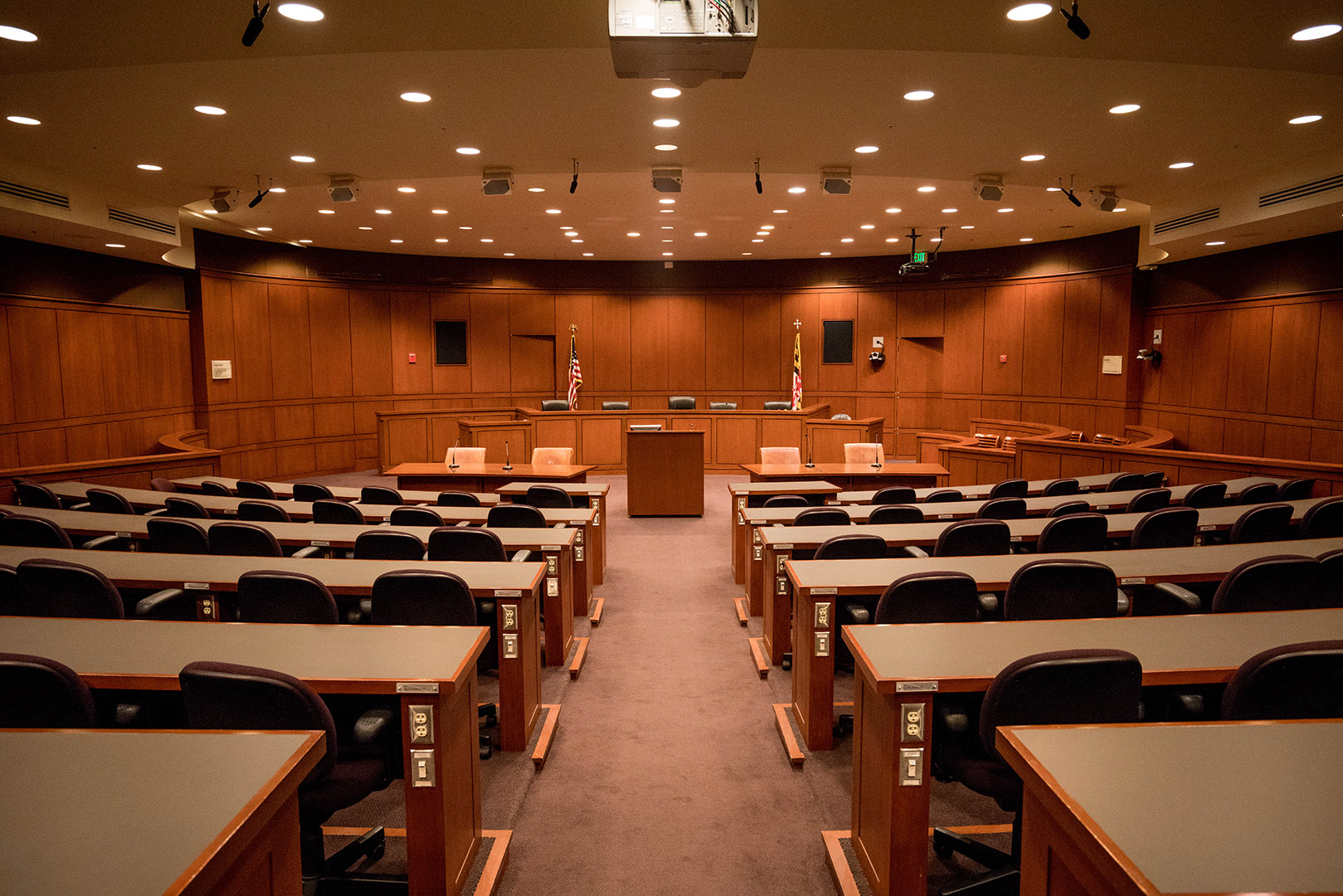
The Asper Judicial Externship Program offers opportunities for law students to obtain credit for supervised law-related work with state and federal judges.
Legislative / Congressional Externship Program
If you hope to pursue a career in public service, our Legislative/Congressional Externship Program will give you a preview of what life is like on Capitol Hill.

Recent Externships
- District Court of Maryland ADR Program
- Maryland Commission on Civil Rights
- Maryland Court of Special Appeals, Office of Mediation
- National Institutes of Health Office of the Ombudsman
- Federal Communications Commission
- Federal Trade Commission
- Financial Industry Regulatory Authority
- Johns Hopkins Technology Transfer
- NFL Players Association
- Securities and Exchange Commission
- U.S. Attorney's Office
- U.S. Bankruptcy Court
- U.S. Department for the Treasury
- World Bank
- Attorney General of Maryland
- Baltimore City State's Attorney's Office
- Baltimore City Office of the Public Defender
- Department of Justice, Criminal Division
- District Courts of Pennsylvania
- Miami-Dade State's Attorney's Office
- National Women's Law Center
- Office of the Federal Public Defender
- Office of the Secretary of the Navy
- U.S. Immigration & Customs Enforcement
- Cybersecurity & Crisis Management/ Center for Health & Homeland Security
- Baltimore City Health Department
- Hospitals and hospital coalitions
- Maryland Department of Health and Mental Hygiene
- U.S. Department of Health and Homeland Security
- U.S. Department of State, Office of Anti-Terrorism Assistance
- Center for International Environmental Law
- Chesapeake Bay Foundation
- Environmental Law Institute
- The Environmental Protection Agency
- Federal Energy Regulatory Commission
- National Oceanic and Atmospheric Administration (NOAA)
- National Wildlife Federation
- Natural Resources Defense Council
- U.S. Department of Energy
- World Health Organization (Geneva)
- CareFirst Blue Cross Blue Shield Office of the General Counsel
- Center for Medicare Advocacy, Inc. Healthcare Rights Project
- Center for Consumer Information and Insurance Oversight
- Maryland Disability Law Center
- Medstar Health
- National Human Genome Research Institute
- National Institutes of Health
- Network for Public Health Law- E Region
- Pharmaceutical Manufacturers Association
- Project Heal, Center for Innovation and Leadership in Special Education
- Food and Drug Administration
- Johns Hopkins Office of Technology Transfer
- Smithsonian Institutions
- The United States Copyright Office
- U.S. Patent and Trademark Office (PTO)
- Inter-American Court of Human Rights (San Jose, Costa Rica)
- International Non-Governmental Organizations
- South Africa Externship Program (human & civil rights law organizations)
- U.S. Department of State
- U.S. District Court for the District of Maryland
- Supreme Court of Maryland
- Appellate Court of Maryland
- Baltimore City Circuit Court
- U.S. Bankruptcy Court for the District of Maryland
- The Committee on Environment and Public Works, U.S. Senate
- The Committee on Health, Education, Labor, and Pensions, U.S. Senate
- The Committee on Homeland Security, U.S. House of Representatives
- The Committee on Homeland Security and Governmental Affairs, U.S. Senate
- The Committee on the Judiciary, U.S. Senate
The Committee on Oversight and Government Reform, U.S. House of Representatives - The Committee on Transportation and Infrastructure, U.S. House of Representatives
- The Committee on Veterans' Affairs, U.S. House of Representatives
- The Honorable Benjamin L. Cardin, U.S. Senate
- The Honorable Rodney Davis, U.S. House of Representatives
- The Honorable Dick Durbin, U.S. Senate
- The Honorable Andy Harris, U.S. House of Representatives
- The Honorable Ann M. Kuster, U.S. House of Representatives
- The Honorable Jan Schakowsky, U.S. House of Representatives
- The Honorable Jeanne Shaheen, U.S. Senate
- The Permanent Subcommittee on Investigations of the Committee on Homeland Security and Government Affairs, U.S. Senate
- The Subcommittee on Aviation of the Committee on Transportation and Infrastructure, U.S. House of Representatives
- The Subcommittee on the Constitution and Civil Justice of the Committee on the Judiciary, U.S. House of Representatives
- The Subcommittee on the Constitution, Civil Rights and Human Rights of the Committee on the Judiciary, U.S. Senate
- The Subcommittee on Fisheries, Water, and Wildlife of the Committee on Environment and Public Works, U.S. Senate
- Asper Fellowships
- Legislative/Congressional
- Legislative and Congressional Externship
- Public Interest
- ACLU Maryland
- Kids in Need of Defense
- NAACP
- SAFE Center Human Trafficking Survivors College Park, Maryland
- SurvJustice Inc.
- House of Ruth
- National Women's Law Center
- The Tahirih Justice Center
- Women's Law Center of Maryland
Student Stories



Contact Us
For additional information about externships, contact: