
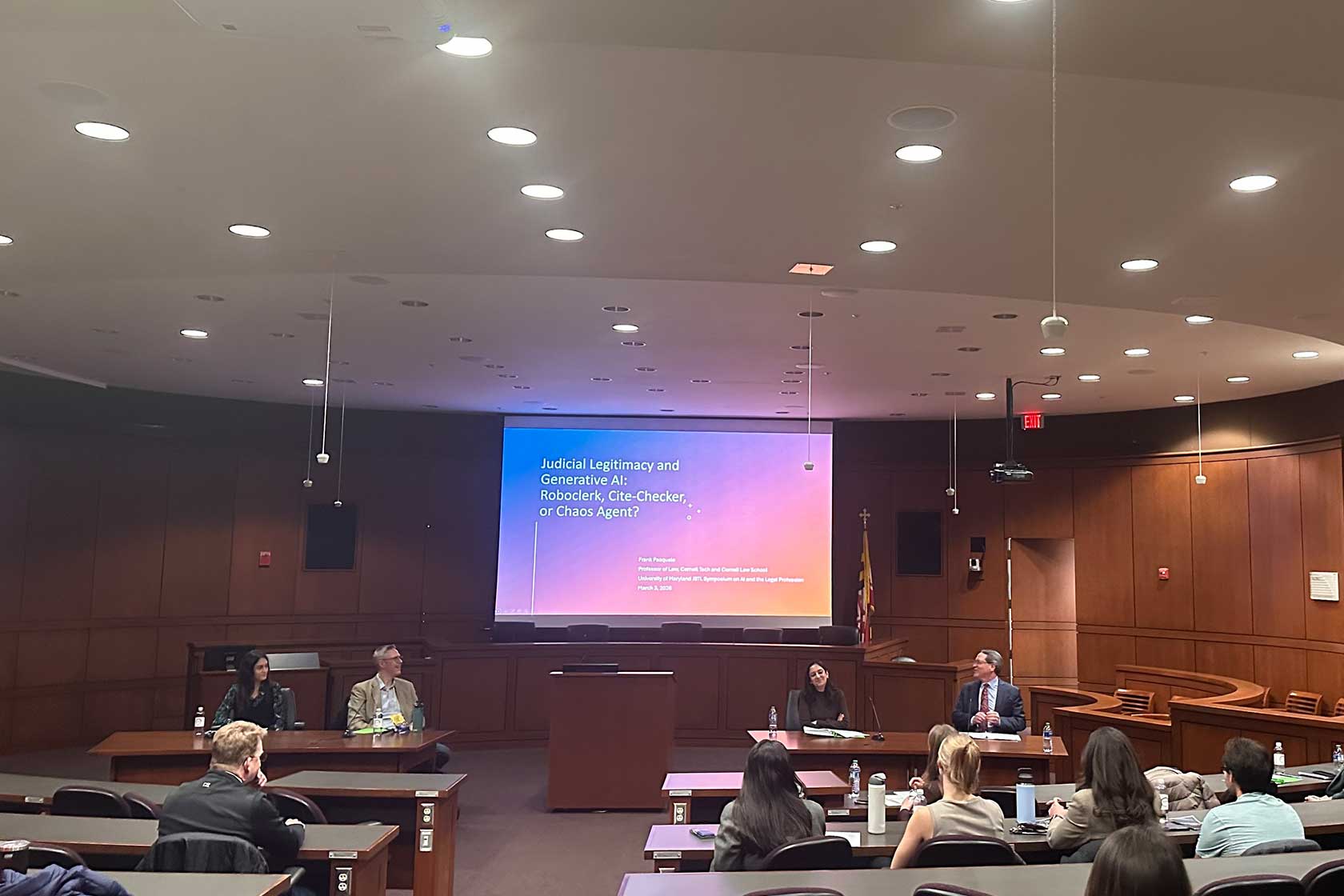
The Journal of Business and Technology Law (JBTL) hosted its annual symposium on March 3, 2026, titled "Justice in the Age of AI". Organized by Symposium Manager Lilly Grant ’27, the event brought students, faculty, and alumni together to examine how artificial intelligence is reshaping legal education, professional responsibility, and democratic institutions.
The program featured scholars whose work addresses the legal profession’s response to emerging technologies. Associate Professor Jessica Lynn Wherry of the University of Baltimore School of Law addressed the role of professional identity in an AI-enabled practice environment. In "Professional Identity as a Tool for AI Risk and Regulation in Law Practice," Wherry explored how attorneys must act as the regulation in accordance with ethical rules when they integrate AI tools into daily work.
Dr. Josh Abrams, Instructional Design Specialist at UMBC, continued the discussion with his presentation, "From the Classroom to the Courtroom: Closing the AI Literacy Gap in Legal Education." Abrams argued that law schools must equip future lawyers with a working understanding of AI systems. Without that foundation, lawyers may struggle to evaluate the tools their clients and courts increasingly rely on. Both panelists highlighted the need for “humans to remain in the loop” when it comes to the use of AI in the legal field.
The symposium also included Frank Pasquale, Professor of Law at Cornell Tech and Cornell Law School, who addressed the growing use of technologies in "Inherently Deceptive AI". Pasquale examined the concern that AI systems are potentially biased and have a lack of empathy, emphasizing the attorney’s duty to think.
Elena Ponte, Federal Trade Commission, presented "Market Concerns Around AI Training Data", based on her journal article, "Reinforcement Learning: A Paradigm Shift in AI Training and its Competitive Implications." Reinforcement learning has become a central AI training method that enables autonomous, goal-oriented behavior and creates new competitive and antitrust challenges in AI-adjacent markets.
Mehak Negpal, Assistant Professor in the Department of Ethics and Business Law at the University of St. Thomas, shared her research, "The Impact of AI on Democratic Institutions", focusing on how automated systems may influence political communication and public trust.
Across the presentations, panelists returned to a shared theme: AI already shapes many aspects of legal practice and public life, yet meaningful oversight still depends on human judgment. The data show a measurable change in how institutions operate. The legal profession must, therefore, build the knowledge and ethical grounding needed to guide that change.