
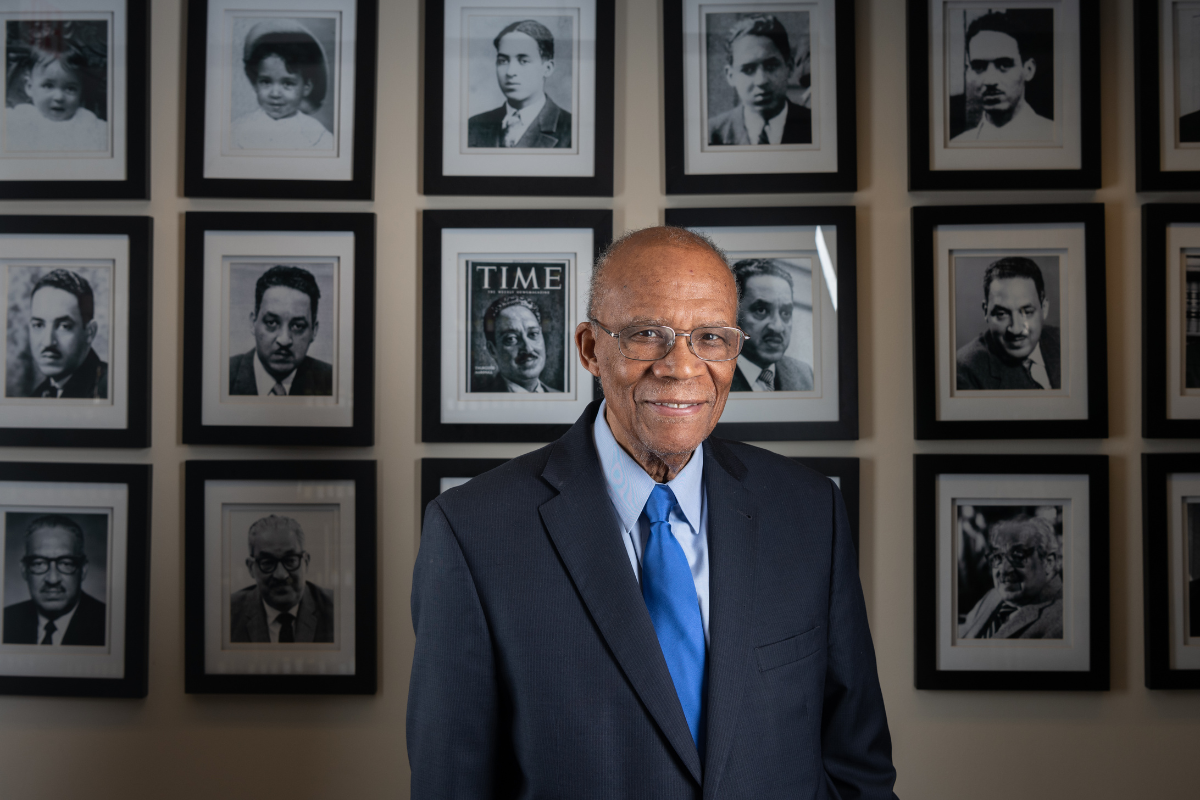
Photo: Professor Emeritus Larry Gibson with an exhibit he created at Maryland Carey Law featuring photographs of Thurgood Marshall spanning the justice’s lifetime.
The long-awaited follow-up to University of Maryland Francis King Carey School of Law Professor Emeritus Larry Gibson's definitive 2012 book on Supreme Court Justice Thurgood Marshall's early life will hit the shelves in early December. Titled Thurgood Marshall: The Conductor, Orchestrating the Battle Against Jim Crow: 1935-1955, the volume, co-authored with Harold Kwalwasser, picks up where Young Thurgood: The Making of a Supreme Court Justice left off, exploring Marshall's work during his time as director-counsel of the NAACP Legal Defense and Educational Fund (LDF).
Before Marshall became the first Black justice of the Supreme Court of the United States, he was a civil rights lawyer and organizer. In Thurgood Marshall: The Conductor, Gibson and Kwalwasser meticulously trace Marshall's movements throughout the South during those two decades when he mobilized (or "conducted" per the book title's metaphor) lawyers, activists, journalists, judges, and allies (his "orchestra") to individually and collectively challenge racial discrimination in the courts, on the ground, and in public opinion.
Writing geographically rather than chronologically, the authors reveal how Marshall tailored his organizing to the conditions specific to each state, identifying partners and raising funds state-by-state to support a range of local anti-discrimination litigation that laid the groundwork for landmark civil rights Supreme Court cases to come.
"What fascinated us was Thurgood Marshall's ability to adapt to different situations," said Gibson, giving Kwalwasser credit for recognizing Marshall's agility as a political operator. "Marshall could quickly come into a state, see what, if anything, he had to work with there, and then adopt a strategy or approach to get people on a local level to buy in. He also left behind in almost every state a rejuvenated political apparatus that continued and, among other things, produced the Brown v. Board of Education decisions."
Turns out that what Marshall "had to work with" were both the local collaborators and what the authors call "the most important cases not to reach the Supreme Court." Particularly, equal pay litigation.
"If you were to ask the average person, even a scholar, to tell you what Thurgood Marshall principally did in the South, they may mention criminal cases or maybe some housing cases," explained Gibson. "But, in fact, his principal entree into almost every state of the South was litigation to get Black teachers and White teachers paid the same."
This book is, possibly, the first deep dive into those obscure but pivotal cases, heretofore largely ignored by historians. Additionally, readers will learn about many of Marshall's voting rights, transportation, university admissions, military, and criminal justice cases between 1935 and 1955.
The book culminates by recounting the assembly of the five court cases that were ultimately combined to produce the opinion in Brown v. Board of Education, which declared racial segregation in public schools unconstitutional.
And while the chapters are presented by state rather than chronologically, the authors also created a separate travel log reflecting several of Marshall's southern journeys with an accompanying timeline.
In another appendix, Gibson and Kwalwasser identify the host of individual lawyers, activists, journalists, and judges who made up the "orchestra," answering the call of the "conductor" to collaborate in opposition to discriminatory law, policy, and practice.
As with his first book, which was the only biography endorsed by the Marshall family, Gibson had extraordinary access to source materials directly from the Marshalls that helped him and Kwalwasser piece together this historical record. Indeed, Marshall's widow Cecilia "Cissy" Marshall invited Gibson to be the only person outside of the family to visit the Marshall home's basement filled with artifacts from the justice's life and career, including his gavel and correspondence.
A close personal relationship between the Gibson and Marshall families, both Baltimore mainstays, engendered this trust.
It all began in 1975 when Marshall was on the bench and Gibson was a hungry young civil rights lawyer who had the gumption to knock on the justice's door late one night seeking a signature on a court order. To Gibson's surprise, Marshall answered the door, signed the order, and wound up chatting for over two hours about growing up in Baltimore. As the years passed, their connection strengthened through a shared network of Baltimoreans, and the men's wives (now both deceased) became close friends. Thurgood Marshall, Jr. wrote the forward to Young Thurgood.
"I am blessed and enjoyed very much the special relationship with the Marshall family," said Gibson.
Q&A with attorney and social worker Eliza Steele '20
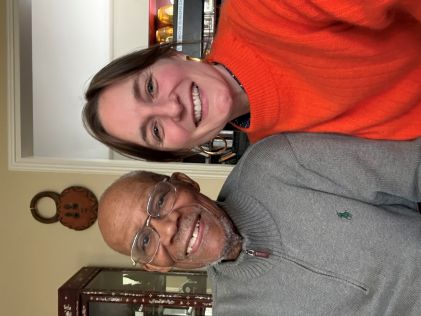 Eliza Steele '20 (left), who has worked closely with Professor Emeritus Larry Gibson on the final stages of the book's production, is part of a deep legacy of public service in Maryland. Her father, Nevett Steele '67 is a prominent Maryland attorney who, with Maryland Carey Law Professor Emeritus Michael Millemann, founded the Maryland Volunteer Lawyers Service, and served as president of the Public Justice Center. Eliza Steele is also related to Isaac Nevett Steele (1809-1891) who studied law under Maryland Carey Law's founding dean David Hoffman and was deputy attorney general for Baltimore County and charge d'affaires for Venezuela. She is a dual graduate of the University of Maryland, Baltimore, earning a JD from Maryland Carey Law in 2020 and an MSW from the School of Social Work in 2019.
Why did you take the opportunity to assist Professor Gibson with this book?
My father, Nevett Steele (class of 1967) has known Larry for 50 years and has tremendous respect for him as a colleague. I developed my own respect for Larry when I took Race and the Law and saw that we shared a deep appreciation for Baltimore and its stories. I knew working on the book would give me a chance to learn more about Larry and his life, Thurgood Marshall's work, and civil rights history. Hard to pass up!
Why is this book important historically?
The book is a very well-researched account of what went into Thurgood Marshall's southern campaign and why it was successful. It shows how social change movements require strong leadership that sees and incorporates the power of the community. Thurgood's work was successful because he was a savvy community organizer and a brilliant lawyer.
Why did you choose to pursue law?
My dad has a lot to do with my decision to go to law school—he is the reason I started my professional life in juvenile justice reform. It didn't take long to see the contradictions of our criminal legal system and the harm it does to our society. I wanted to be a part of re-imagining that system.
How are you combining your law and social work degrees to pursue justice for your clients?
My training, my work, and the people I have met along the way have deepened my understanding of social problems and helped me to think creatively about possible solutions. Right now, I am very excited about a project I am working on to bring paid knowledge work to young people in the justice system. So many of the young people I have met in Baltimore do not really have a viable way to grow up, and they end up getting punished for what is at its root a systemic failure. My dream is to help build a system that guarantees young people a good wage to share their skills with each other and the community at large, thereby alleviating the very real financial pressures they face, and creating an outlet for their leadership, talents, and desire to make positive contributions.