
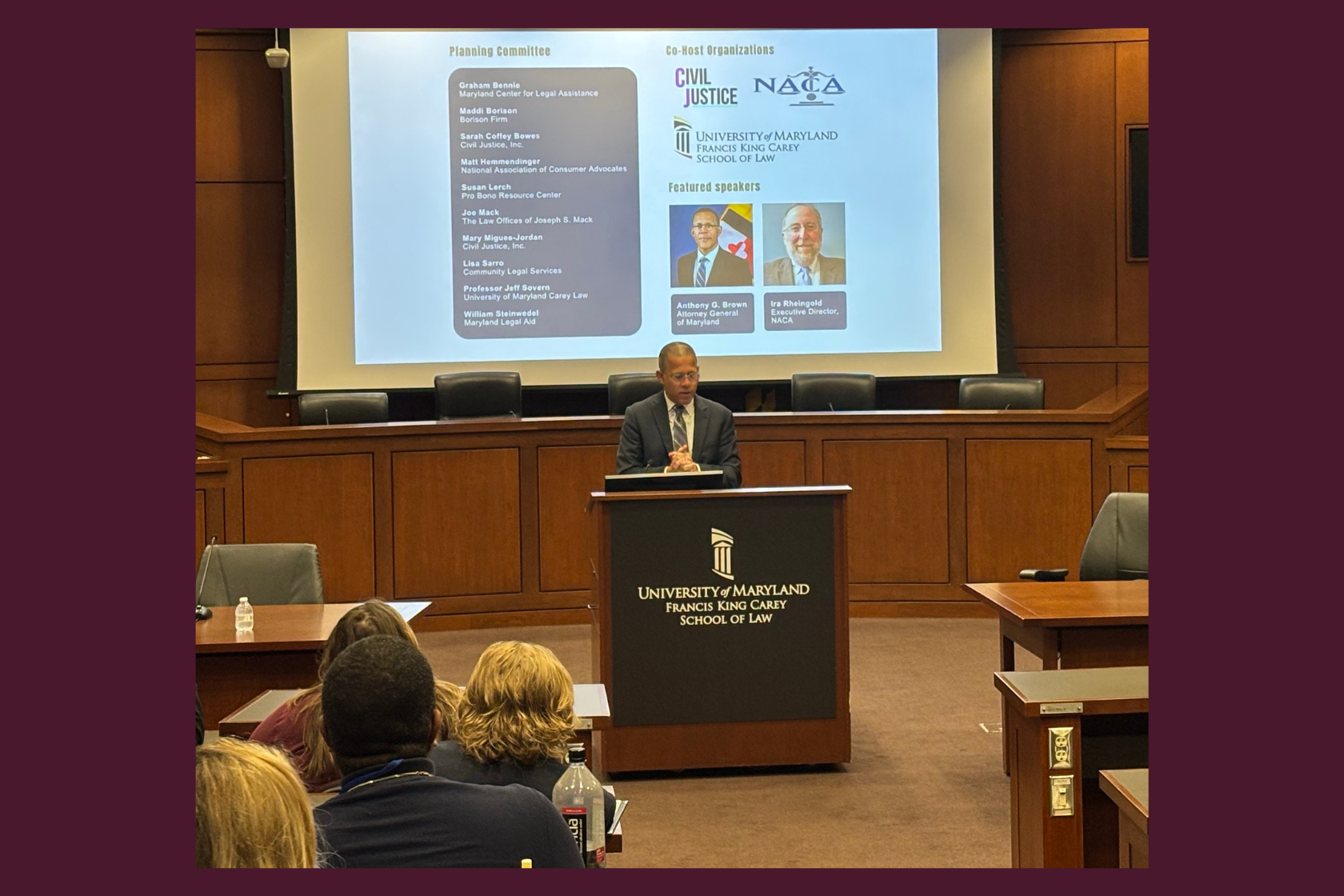
Photo: Maryland Attorney General Anthony Brown offered remarks at the Consumer Law Symposium
The packed Ceremonial Courtroom at the University of Maryland Francis King Carey School of Law buzzed with terms like “consumer justice,” “tenant protection,” and “fair credit reporting.”
That’s because Maryland Carey Law was the host site for Maryland’s first consumer law conference co-presented with Civil Justice, Inc. and the National Association of Consumer Advocates. The September symposium brought together legal service organizations, government leaders, private attorneys, and members of the judiciary for a day of networking, collaboration, and legal education focused on the most urgent consumer issues facing Marylanders.
Opening speakers included Maryland Carey Law consumer law Professor Jeff Sovern; Sarah Coffey Bowes ’04, executive director of Civil Justice, Inc.; Dean Renée H. Laurent; and Maryland Attorney General Anthony G. Brown. Ira Rheingold, executive director of the National Association of Consumer Advocates, offered the keynote.
Panels covered topics including affirmative consumer litigation, litigation strategy, and the future of consumer law in Maryland. Area judges also spoke on a panel.
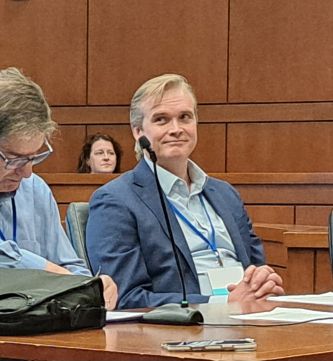 Consumer attorney Ben Carney ’04 (left) was a panelist at the symposium. Carney is a partner at Gordon, Wolf & Carney, where he represents everyday people in high-stakes litigation, having secured tens of millions in relief for thousands of people in class-action cases.
In this Q&A, Carney talks consumer law and offers advice for students interested in the practice.
What is your main takeaway from the Consumer Law Symposium?
My biggest takeaway was the value of the consumer-law community itself, which was well represented with the full house that showed up for the symposium. Good consumer lawyering requires more than knowing the law; it requires judgment about which cases to bring, how to litigate them, what the client actually needs, and when an individual problem may reflect something much larger. Bringing together lawyers from private practice, legal services, government, and academia gives all of us a chance to learn from one another and ultimately do better work for consumers.
What advice would you give Maryland Carey Law students interested in pursuing careers in consumer law?
Get as much hands-on experience as you can, and don’t wait until you feel like an expert. Take consumer-law courses and clinics, learn civil procedure and the nuts and bolts of litigation, and seek out lawyers whose work you admire. Some of the most important opportunities in my career came from saying yes to an opportunity, doing the work carefully, and allowing one case or one relationship to lead to the next.
What inspires your continued involvement with the law school as a member of the Board of Visitors and participant in activities like the Consumer Law Symposium?
Maryland Carey Law gave me much more than a degree. It introduced me to people and opportunities that fundamentally shaped my career. Serving on the Board of Visitors and participating in programs like the Consumer Law Symposium are ways for me to give something back and, I hope, help current students find some of the same opportunities and relationships that the law school gave me.
Thinking back to your law school days, which people/classes/opportunities had a positive impact on you and helped contribute to your success?
Professor Emeritus Mike Millemann had an enormous influence on me. I took every clinic I could with Mike, even getting permission to take additional clinical credits, and he really began my involvement in Maryland consumer law. Denis Murphy’s Law Practice Management class also had a lasting impact on me because he showed me that it was possible to build a small, independent practice around meaningful work and to practice law on your own terms. And my work in the clinic also led me to become acquainted with Nevett Steele, Jr. ’67, who worked as a U.S. Attorney; as a partner at Whiteford, Preston and Taylor, represented death-row inmates; helped establish the Maryland Volunteer Lawyers Service; co-founded the Public Justice Center with Mike Millemann and later led Civil Justice, Inc. His career showed me that you could be a first-rate litigator as a solo or small firm attorney and still make public service and access to justice a central part of your professional life. Those relationships helped me see what kind of lawyer I wanted to become.