
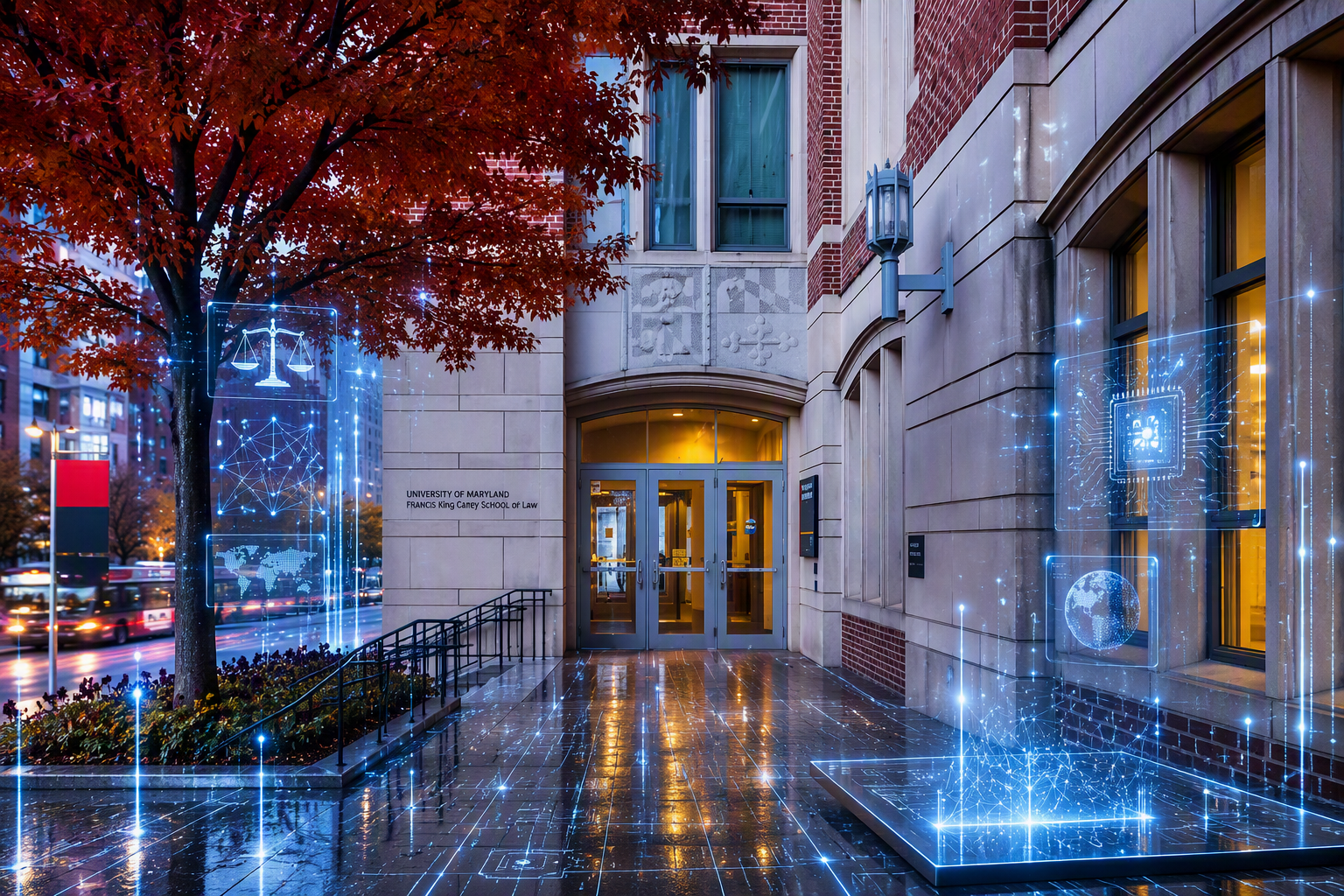
Image: created with AI assistance
The University of Maryland Francis King Carey School of Law has long been a hub for teaching and scholarship at the intersection of technology and the law.
That expertise is getting noticed. In 2026, the law school received two national recognitions for excellence in technology law.
The first is the highly selective Insight Into Academia Excellence in Innovation recognition. The distinction honors Maryland Carey Law for being “forward-thinking and a nationally recognized leader” in tech/law. Additionally, Maryland Carey Law this year received an A+ for Technology Law from National Jurist, which selected just 12 law schools across the country for the top ranking.
These honors reflect that Maryland Carey Law offers one of the most extensive law and technology curricula in the country, spanning foundational instruction, advanced skills-based training, and specialized doctrinal courses, with unparalleled experiential learning opportunities. And while around 25 courses in the catalog include the words “technology,” “AI,” or “cybersecurity” in their titles, faculty across all areas of study inject technological considerations into their work. Whether exploring the environmental impact of data centers, the privacy issues around the storage of genetic information in commercial databases, or the effect of surveillance technologies on civil rights, professors at Maryland Carey Law are leading thinkers readying students for the extraordinary omnipresence of technology in everyday life.
“Maryland Carey Law is reimagining legal education as an integrated ecosystem that prepares students not only to understand technological change, but to lead, shape, and govern it,” said Dean Renée H. Laurent.
Well Established Tech-Specific Career Preparation
For students who wish to specialize in areas of the law specific to technology, Maryland Carey Law provides pathways to developing deep expertise.
One of the first law schools in the country to offer a Cybersecurity and Crisis Management Law Program, Maryland Carey Law enables JD, LLM, and MSL students to specialize in cybersecurity as they earn their degrees. The program provides opportunities for classroom as well as hands-on education through the University of Maryland Center for Cyber, Health and Hazard Strategies (CHHS), a university center that helps clients navigate the complex cybersecurity and emerging technologies landscape through education, planning, training and exercises.
CHHS serves as a bridge between scholarship, public policy, and operational practice, providing students with opportunities to participate in research, policy development, and client engagements relating to cybersecurity, artificial intelligence, emergency preparedness, and critical infrastructure resilience.
“Today’s technology lawyers need more than legal doctrine. They need to understand how technology works, how organizations manage cyber risk, and how governments are responding to emerging challenges such as artificial intelligence, critical infrastructure protection, and digital resilience,” said Markus Rauschecker, executive director of CHHS, who teaches courses in cybersecurity, information privacy, and cybercrime. “Our goal is to give students opportunities to work on these issues in real-world settings alongside the organizations making policy and operational decisions.”
The Cybersecurity and Crisis Management Law Program’s courses are taught primarily by CHHS staff, most of whom are Maryland Carey Law graduates. These faculty are national leaders in the field, consulted both by CHHS’s clients and local and national media outlets.
Students also benefit from a robust externship program at CHHS where they get real-world experience working with clients on issues related to cybersecurity, infrastructure protection, artificial intelligence governance, and more. Clients and partners have included the Baltimore City Office of Emergency Management, the Federal Emergency Management Agency (FEMA), the Maryland Governor’s Office of Homeland Security, the National Security Agency, and the U.S. Department of State.
Through their work with CHHS, Maryland Carey Law students also have opportunities to support the Maryland Cybersecurity Council, currently chaired by Rauschecker, and the Maryland Artificial Intelligence Workgroup, for which CHHS serves as staff. Students conduct research and policy analysis that informs statewide recommendations on cybersecurity, data privacy, and artificial intelligence governance, providing them with first-hand experience at the forefront of emerging technology law and policy.
Additionally, US Cyber Command selected Maryland Carey Law —the first law school to be invited—to join its Academic Engagement Network. The network fosters relationships among innovative academic institutions and the entire US Cyber Command enterprise. As a member, Maryland Carey Law enables students to take advantage of collaborative projects, internships and recent grad opportunities, mentorship, and more. In 2025, Maryland Carey Law students won first place in the US Cyber Command Cyber Research and Education Conference (Cyber RECon) earning both the Top Strategist Award and the best overall Commander’s Cup. In 2026 Maryland Carey Law followed up that achievement with first place in the conference’s Expo Strategist Category, by presenting research addressing real-world national security cyber challenges.
Graduates of the program go on to prestigious positions in data privacy, cybersecurity, and artificial intelligence at government agencies, law firms, and corporations.
Rachel Cooper ’17 graduated with a cybersecurity certificate and quickly launched an impressive career trajectory in cybersecurity and global privacy at companies including Under Armor and Meta.
Today, she is a senior associate in data protection, privacy, and cybersecurity at the highly regarded Am Law 200 firm Norton Rose Fulbright, where she advises clients on compliance with data protection and privacy laws.
Cooper credits the program with opportunities that prepared her to hit the ground running when she graduated.
“I appreciated the opportunity to learn about cybersecurity and privacy law in the classroom and then apply that knowledge through externship experiences,” said Cooper. “The program also created valuable networking opportunities and helped me land my first job.”
A former member of the Maryland Carey Law Alumni Board, Cooper frequently connects with current students seeking career advice, remembering that when she was starting out, there were fewer people to turn to in the emerging field.
“I enjoy helping students understand the different career paths available in this space,” Cooper added, “and sharing why it is such a dynamic and rewarding area of practice.”
New Horizons
As well as the Cybersecurity and Crisis Management Program, Maryland Carey Law offers a rigorous Intellectual Property and Technology Law Program, including specialty tracks for JD and LLM students, which has always had a deeply embedded technology component.
After all, central to IP is the legal framework around patenting new inventions, which often involve emerging tech.
“If you have an IP program, you have a technology focus,” said Professor Patricia Campbell, the program’s director. “You can't do patent law without being technology focused.”
Recently, the program has been able to increase its capacity in the technology arena thanks to Maryland Carey Law’s establishment of a new Small Business Clinic. In the 2010s, the IP clinic spent much of its bandwidth assisting entrepreneurs with setting up their small businesses alongside its work with inventors seeking patents, trademarks, and other IP protections. Now, the Small Business Clinic will serve the bulk of the entrepreneurial clients, giving Campbell’s group space to work with more inventors on patent and copyright issues for inventions such as advanced medical devices, drone technologies, and new software.
The program is also expanding student training to include the exploration of novel legal issues such as the patentability of machine learning inventions and protectability of creative works made using generative AI. In the classroom portion of the clinic, students consider the use of emerging technological tools in law practice, including artificial intelligence platforms for legal research generally, and specifically, for patent preparation, drafting of technology licenses, and IP management.
Reflecting the shift in emphasis, Maryland Carey Law has renamed the IP academic program the Intellectual Property and Technology Law Program. Likewise, the clinic is now the Intellectual Property and Technology Law Clinic, and the IP legal resource center run by Campbell, which encompasses the clinic and includes community trainings, is now called the Maryland Intellectual Property, Technology and Entrepreneurship Center (MIPTEC).
Karachi Achilihu graduated from Maryland Carey Law in 2019. Before establishing her own consultancy, Achilihu worked at Am Law 100 firms and at Meta Platforms where she managed legal review of content, production, and platform deals across Meta, Facebook, Instagram, and Reality Labs.
“As both a technology transactions lawyer and alum of one of the academic institutions recognized for its strong technology law programs, I am pleased to see law students’ growing interest in and exposure to the intersection of law and technology,” wrote Achilihu in an unsolicited testimonial on LinkedIn.
“Although I pursued my law school’s Business Law Program as an aspiring corporate lawyer back then, it is clear that my law school prepared me for my current legal practice as a tech lawyer.”
Cutting-Edge Courses
Students at Maryland Carey Law can choose from an array of courses on technology law and policy that touch a variety of practice areas and explore regulation, policy, and practical use of technology. They include Law & Policy of Artificial Intelligence; Law and Policy of Cybersecurity; Advanced Bioethics; Race, Technology and the Law; and Law, AI and Big Data.
Professor Liza Vertinsky, a nationally recognized expert on the regulation of health care markets and emerging technologies, developed a course titled Regulating Emerging Technologies. Vertinsky guides students through a range of technological developments, including advances in genetics, artificial intelligence, and fintech, and the ways those advancements are impacting markets and challenging the existing legal and regulatory frameworks protecting the public.
“Students are learning not just the legal issues,” said Vertinsky, “but also the ethical and policy issues raised by emerging technologies and how they are being used.”
In a world where generative AI tools pervade everyday life, students are also preparing to ethically integrate AI tools into their lawyering.
“Our students are being trained to use AI for workflow efficiencies in legal practice settings,” said Ursula Gorham, executive director of data and educational technologies, pointing out that firms now expect lawyers to save time and money by deploying AI tools.
Gorham's popular course Advanced Legal Research: AI Skills for Lawyers teaches students to work with advanced legal AI platforms to conduct research, evaluate AI-generated content, and draft legal documents with appropriate oversight, integrating AI tools with traditional legal methods to produce accurate, responsible, and practice-ready work product.
Students seeking to become tech lawyers also have options like the innovative Cyber Boot Camp—Tech for Cyber Lawyers, developed and taught by Mark Cather ’20, chief information and privacy officer for the University System of Maryland. The short course helps future attorneys develop a foundational understanding of networks, cybersecurity, cloud computing, artificial intelligence, and other core technologies. Students also learn to communicate effectively with technical professionals and advise clients on complex technology-related matters.
Journal of Business and Technology Law
Bringing together multiple areas of study, including business, health, and technology law, the Journal of Business and Technology Law gives students a chance to engage deeply with scholarship around everything from the effect of technology on securities markets, to the impacts of the copyright law on e-commerce startups, to the invention of new business models for vaccine development. The student-managed journal publishes professional and student articles, reports, surveys, and book reviews.
Faculty
Bolstering the academic offerings and experiential training in technology law at Maryland Carey Law are nationally and internationally recognized faculty experts whose research and teaching address critical issues such as AI governance, surveillance, data-driven policing, biotechnology, and cybersecurity. They include:
Chaz Arnett, Professor
Select Scholarship
- “Dystopian Dreams, Utopian Nightmares: A.I. & the Permanence of Racism,” Georgetown Law Journal
- “Crowdsourcing Surveillance,” UCLA Law Review Discourse
- “Black Lives Monitored,” UCLA Law Review
Courses Include
Andrew Blair-Stanek, Professor (and computer scientist)
Select Scholarship
- “ChatGPT Generates a Novel Tax Strategy,” Tax Notes Federal
- “BLT: Can Large Language Models Handle Basic Legal Text?” in Proceedings of the Natural Language Processing Workshop (with others)
- “OpenAI Cribbed Our Tax Example, But Can GPT-4 Really Do Tax?” in Tax Notes Federal (with others)
Courses Include
Patricia Campbell, Professor; Director, Intellectual Property and Technology Law Program; Director, Maryland Intellectual Property, Technology and Entrepreneurship Center
Select Scholarship
- “Debugging the Trademark Laws Part II: Criminal Penalties for Trafficking in Counterfeit Microelectronics,” SMU Science & Technology Law Review
- “Debugging the Trademark Laws: The Lanham Act and Counterfeit Microelectronics,” Texas Intellectual Property Law Journal
Courses Include
Ursula Gorham, Executive Director, Data and Educational Technologies
Select Books
- Foundations of Information Law
- Understanding Human Information Behavior: When, How, and Why People Interact with Information
- Access to Information, Technology, and Justice: A Critical Intersection
Courses Include
David Gray, Professor
Select Scholarship
- The Fourth Amendment in an Age of Surveillance (Cambridge University Press)
- “Fourth Amendment Hydraulics and Programmatic Surveillance,” American University Law Review
- “Is Google a State Agent?” in Stanford Technology Law Review
Courses Include
Diane Hoffmann, Professor and Director, Law and Health Care Program
Select Scholarship
- “AI in Residency Application Reviews: Emerging Legal Risks,” JAMA
- “FAIRS - A Framework for Evaluating the Inclusion of Sex in Clinical Algorithms,” New England Journal of Medicine
- “Clinical Algorithms, Antidiscrimination Laws, and Medical Device Regulation,” JAMA
Courses Include
Guha Krishnamurthi, Professor
Select Scholarship
- “Criminal Justice in the Data State,” Houston Law Review
- “The Many Ways of Constitutional Discourse,” Texas Law Review Online
- “The Virtues of Optional Legislation,” Arizona State Law Journal
Courses Include
Natalie Ram, Professor
Select Scholarship
- “Privileging Genetic Privacy,” Emory Law Journal
- “The Precarious Future of Consumer Genetic Privacy,” Science
- “America's Hidden National DNA Database,” Texas Law Review
Courses Include
Daniel Rauch, Assistant Professor
Select Scholarship
- “Defamation as Democracy Tort,” University of Pennsylvania Law Review
- “Customized Speech and the First Amendment,” Harvard Journal of Law & Technology
- “Sherman's Missing 'Supplement': Prosecutorial Capacity, Agency Incentives, and the False Dawn of Antitrust Federalism,” Cleveland State Law Review
Courses Include
Markus Rauschecker, CHHS Executive Director and Maryland Carey Law Lecturer
Courses Include
Jeff Sovern, Professor
Select Scholarship
- “Not-so-Smartphone Disclosures,” Arkansas Law Review
- “Borrow Now, Protect Later,” Denver Law Review
- “Is Discrimination Unfair?” in Georgia State University Law Review
Courses Include
Liza Vertinsky, Professor (and economist
Select Scholarship
- “Reorienting Patent Policy Towards Responsible AI Design,” Research Handbook on the Law of Artificial Intelligence
- “A Relational Approach to Public Private Contracting for Innovation: The Example of ARPA-H,” Case Western Reserve Law Review
- “Theory of Genetic Dimensions in the Law, Polygenic Risk Scores, and Reproductive Decision-Making,” Harvard Journal of Law & Technology
Courses Include
Chris Webster, CHHS Senior Research Associate and Maryland Carey Law Lecturer
Select Scholarship
- “Criminalizing Deceptive Deepfakes: A Novel Approach Rooted in Common Law Tradition,” U. Balt. L.F. (online publication pending) (with Benjamin Yelin)
Courses Include
Ben Yelin, CHHS Program Director, Public Policy & External Affairs, and Maryland Carey Law Lecturer
Select Scholarship
- “Criminalizing Deceptive Deepfakes: A Novel Approach Rooted in Common Law Tradition,” U. Balt. L.F. (online publication pending) (with Christopher Webster)
- “From AI Ideas to Institutional Priorities: A Case Study of a Faculty-Led Pipeline for AI-Enhanced Learning,” Association for the Advancement of Computing in Education (AACE) (with others)
- “Law and Policy of Artificial Intelligence,” CLARK curriculum collection
Courses Include