
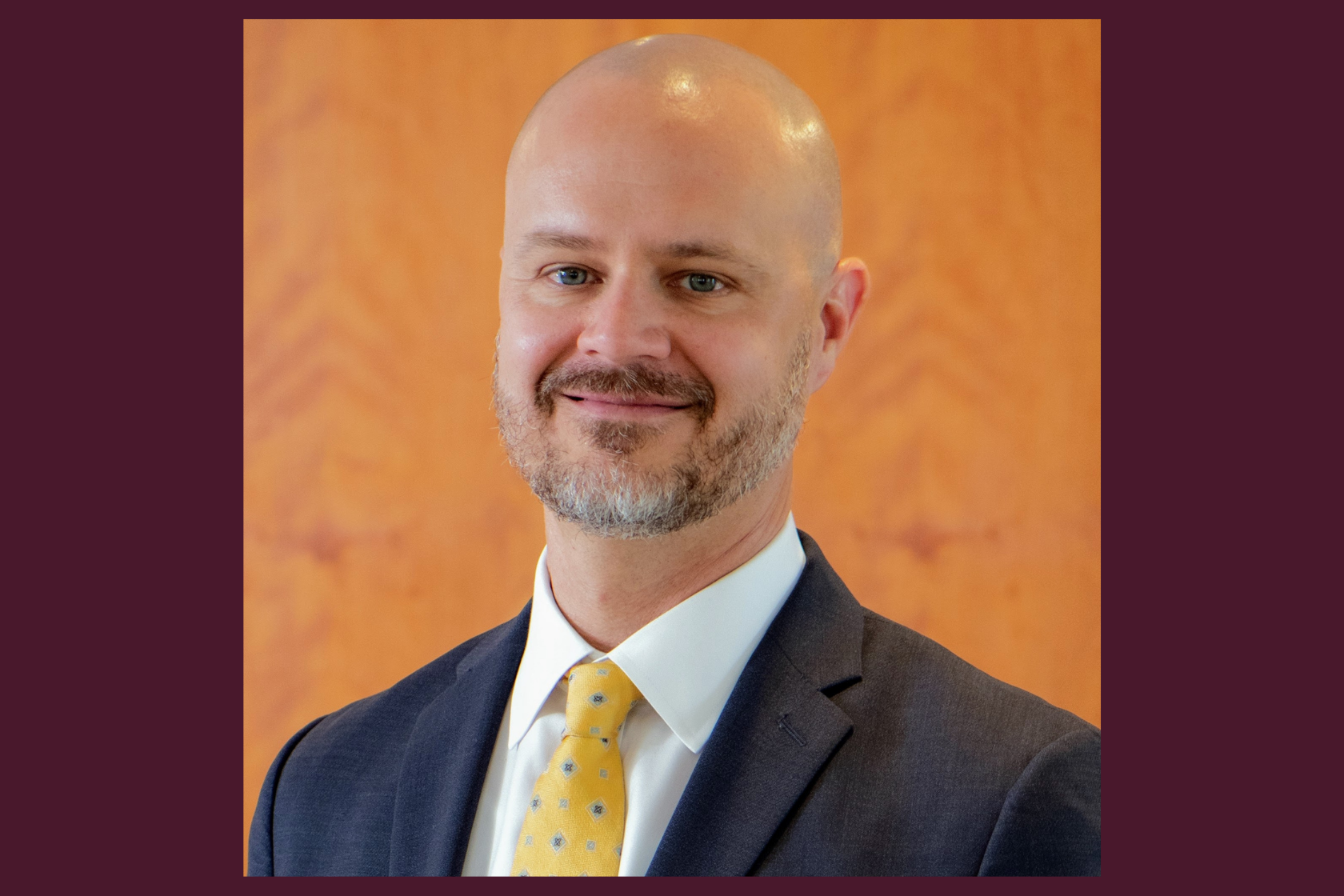
Adam Crandell ’10 came to Maryland Carey Law intending to pursue a career in foreign policy and international relations. But his plans changed after he joined the Immigration Clinic, which was then run by Professor Maureen Sweeney—a clinic now housed in the Chacón Center for Immigrant Justice, which Sweeney directs.
“It was the first time I had any direct client experience, and certainly the first time I’d had any litigation experience: going to court, building a case, making arguments,” Crandell says. “I loved everything about it.”
Crandell loved it so much, in fact, that after spending a summer in the Human Rights Law Division of U.S. Immigration and Customs Enforcement rooting out human rights violators who had come to the U.S. under false pretenses, he participated in the clinic for a second time. On the one hand, he wanted to assist the next batch of clinic students. On the other, he wanted to see some of his own cases through to completion.
“The lifespan of an immigration case is sometimes five, 10, 15 years or longer,” Crandell says. “I have clients that remember my son as a baby—and now he’s a sophomore in high school.”
After graduation—which was unusually exciting, given that his eldest son was born the day Crandell was to be hooded (“we woke up that morning, prepared to go to graduation, and ended up in the delivery room”)—he landed a job at the immigration firm Berlin & Associates working on removal defense, humanitarian asylum, and family-based immigration. Significantly, Crandell also handled cases that straddled immigration and criminal law.
Known as “crimmigration,” the field had recently come to prominence thanks to the 2010 Supreme Court case Padilla v. Kentucky, where the court ruled that defense attorneys were obliged to advise noncitizen clients about the deportation risks involved in entering a guilty plea. After Padilla, public defenders’ offices had to make sure that they complied with the court’s decision, while criminal defense attorneys had to seek out immigration experts for help understanding how convictions might affect their clients’ immigration statuses.
By the time Crandell was in his final year at Maryland Carey Law, crimmigration had become a hot topic, and Sweeney had emerged as an early pioneer, helping to establish the school as a leader in the field. (It remains so today: In 2023, the Chacón Center brought on Associate Professor Aadhithi Padmanabhan to establish one of the few federal appellate immigration clinics in the country, and, last year, hired Assistant Professor Cori Alonso-Yoder to direct the Immigration Clinic. Sweeney also teaches a new crimmigration law class and co-authored the book Crimmigration Law in a Nutshell.) For a newly minted attorney, navigating uncharted legal waters was exhilarating.
“As a young lawyer, the most fun I had litigating cases was in that area,” Crandell recalls. “There was a lot of license to make creative arguments. And as it turns out, some of them have landed: we have really good case law now, particularly in the Fourth Circuit, because of the arguments that myself and Professor Sweeney and others were able to push through.”
Crandell went on to build a good portion of his practice around crimmigration—first at Berlin & Associates, then at his own eponymous practice, and eventually at Eldridge Crandell, which he established in 2018 with criminal defense attorney Jeremy Eldridge.
Today, much of Crandell’s work involves representing clients who are subject to removal due to criminal convictions, collaborating with Eldridge to undo pleas in which poor advice was given regarding potential immigration consequences, and consulting with other defense attorneys whose noncitizen clients face criminal charges. (When time allows, he and Eldridge also host a podcast, "Lawyers on the Rocks," which features them and their guests—attorneys, judges, and elected officials—discussing the law while sipping whiskey.)
Outside of the office, Crandell shares his expertise as widely as possible. In addition to teaching immigration and crimmigration law at Maryland Carey Law and the University of Baltimore School of Law, Crandell has helped train members of the Maryland Office of the Public Defender and participated in panels and training sessions for the National Immigration Project, the Maryland State Bar Association, and the American Immigration Lawyers Association. Since 2022, he has also served as the pro bono legal clinic director for the Chesapeake Multicultural Resource Center, a nonprofit that offers immigration services to residents of Maryland’s Eastern Shore.
As much as he loves his chosen profession, Crandell admits that working closely with asylum-seekers, detainees, and others who have often suffered gross injustices can take a psychological and emotional toll.
“When you do that, oftentimes you’re going to wear some of what they are wearing,” he says.
But he draws strength from the immigration team he has built at Eldridge Crandell—a team that now includes partner Rachel Girod, as well as two associates, Lauren Wilhelm ’20 and Rachael Savage ’22, who also served in the Immigration Clinic.
And even at the most difficult times, the work itself continues to sustain him. “Sitting down with a client and working on a case really is the best medicine,” he says.
Editor's Note: This story was originally published in Maryland Carey Law's 2026 annual magazine.