In images sent from Artemis II astronauts last spring, our planet appeared like a globe without its map. No nations, borders, or grid lines. Just one world, home to all humans.
Down here on Earth that very same week, members of the International and Comparative Law Program faculty and a Cuban embassy official offered a panel conversation at the law school on recent U.S. interventions in Venezuela, Cuba, and Iran.
Discussion of international conflicts highlighted how the celestial perspective of the “blue marble” belies reality. The world map may be invisible from space, but the divisions that separate people and define power remain heavily drawn and only continue to grow in complexity.
This year, amid global strife, the International and Comparative Law Program celebrated the 50th anniversary of the Maryland Journal of International Law. The milestone was an opportunity to appreciate the journal’s rich history of engaging critically with legal systems that intermingle across those divisions and to gather the strong community of people affiliated with the program.
It was also a time to recognize the importance of the academic program’s expansion of opportunities for students to take innovative courses and engage with a world profoundly different from the one in which the journal was founded.
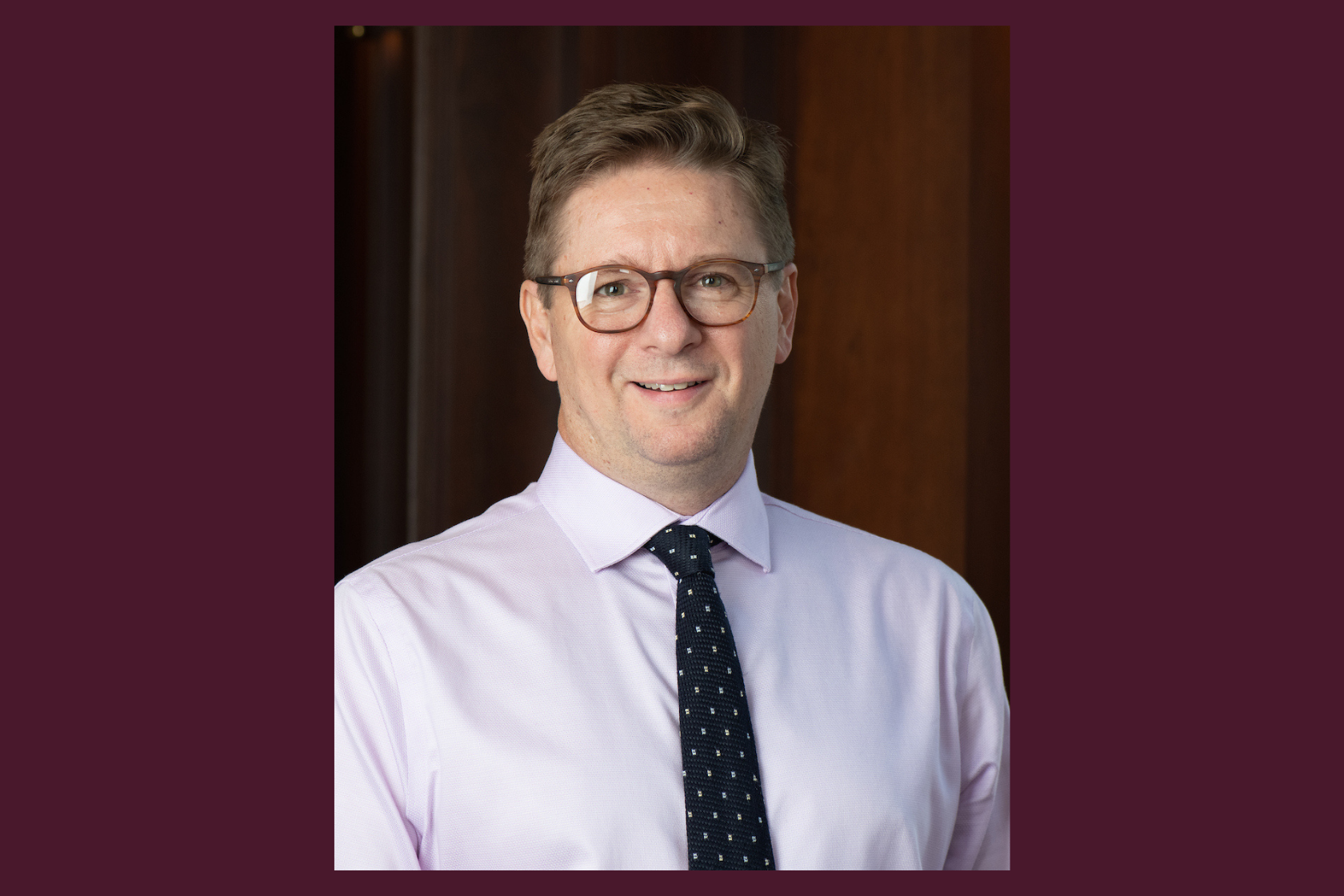
“The current moment is an extraordinary one to reflect on international law and for students to engage with the history and practice of international law,” says Professor Peter Danchin, director of the International and Comparative Law Program (pictured above), whose investiture as the Jacob A. France Professor of International Law was a highlight for the program this year. “Questions about the future of international law and what kind of legal order still exists and may come into existence in the years ahead are the central debates of our time. Here at Maryland Carey Law, we’re working actively to think through these great challenges.”
50 years of scholarship
The combined area of international and comparative law has long been a strength at Maryland Carey Law. Faculty who started as early as the 1970s, including Clinton Bamburger, Hungdah Chiu, and Peter Quint, as well as Sherrilyn Ifill in the 1990s, were pioneers both as scholars and in establishing relationships between the law school and legal institutions around the world.
For example, points out Danchin, “We were one of the only law schools in the country working for legal reform in South Africa before the fall of Apartheid in 1990.” That included an externship program for students to be on staff at the Legal Resources Centre in Cape Town, South Africa—an experience available to this day.
A crown jewel of the program is the student-run Maryland Journal of International Law, for which Danchin serves as faculty advisor. The journal publishes scholarship on a broad range of topics related to international and comparative law and hosts an annual symposium that attracts academics from across the globe.
The journal was started in 1975 by Chiu as The Journal of International Trade Law and underwent a couple of name changes before landing on its current moniker. In 1977, the publication held its first symposium, a conference on legal aspects of U.S. China trade and investment. Through the decades, the work published in the journal tackled everything from Apartheid to the Cold War, corruption in international sports to international environmental impact litigation.
Training ground
As well as being a hub for leading scholarly work, the journal is a training ground for students who go on to distinguished careers in international law.
Thomas Brown ’09 was editor-in-chief when the journal was restarting after a hiatus. “It was an amazing opportunity and a mini leadership clinic,” remembers Brown. The position, he adds, helped him become a better writer.
Now, Brown is senior aviation and admiralty counsel in the U.S. Department of Justice’s Aviation, Space and Admiralty Litigation Section. There, he works on cases that involve collisions in the air and at sea, including the one that caused the catastrophic collapse of Baltimore’s Francis Scott Key Bridge in 2024.
Jennifer Chapman ’17 was editor-in-chief the year corruption in international sports was the symposium topic. She recalls the deep sense of community she found at Maryland Carey Law, which has only grown since she graduated. A first-generation law student who matriculated mid-career, she felt valued in a way that enabled her to flourish.
“I felt welcomed as an individual,” says Chapman, who is now the foreign, comparative, and international law librarian at the University of Virginia School of Law.
Another former editor, Ruth Pritchard-Kelly ’96, parlayed her international law education into a career in satellite regulatory affairs and space law and policy.
“Everybody,” she notes, “has a border with outer space.”
Remarkably, Pritchard-Kelly knew she wanted to work as a “satellite lawyer” more than 30 years ago when she began law school and there was, she says, “barely an Internet.” In those days, satellites had a lot more to do with television than GPS navigation, military reconnaissance, and outer space observation.
These days, Pritchard-Kelly is an internationally recognized expert in the rapidly changing areas of satellite regulatory affairs, sustainable space policy, and, indeed, space law.
Anniversary festivities, which the three alums attended, included this year’s journal symposium titled, “A Half Century of International Law: Critical Reflections, Reimagining Horizons.” The conference featured an impressive array of scholars from far and wide engaged in conversations with Maryland Carey Law faculty on international legal theories, critical histories of human rights, the new “cold peace” in our time, comparative constitutionalism, and transnational law.
Globe hopping
In her opening remarks at Danchin’s investiture, Dean Renée Laurent expressed appreciation for his many contributions to the law school, particularly in building opportunities for students to study international law through innovative classes and study abroad experiences. “Thank you,” said the dean, “for taking our students out into the world and for bringing the world to us right here at Maryland Carey Law.”
Since Danchin joined the Maryland Carey Law faculty 20 years ago, he has built on a strong foundation to create a dynamic academic hub where law students are drawn to study international and comparative law through forward-leaning classes and international experiences alongside some of the leading scholars in the field.
Under his leadership, study abroad opportunities for students have grown significantly. As well as South Africa, Danchin and other faculty members have accompanied students to such far-reaching destinations as Australia, Malawi, Ireland, Italy, Taiwan, and Scotland.
Moreover, through the recently established Eric E. Garvin ’10 Student Exploration Fellowship, students have traveled to Chile, South Africa, and Taiwan. Danchin has also been integral to the development of new courses that enable students to put their heads together with international scholars and other students from around the world to address pressing global issues.
One standout example is the Environmental Justice, Public Health and Human Rights seminar, which Danchin co-teaches with faculty in the Environmental Law and Law and Health Care programs, in conjunction with faculty from the University of Malawi. The seminar includes travel and experiential projects for the Malawian and Maryland students working together in both countries on issues involving the complex challenges of climate change and environmental justice.
Another is the Comparative Constitutional Democracy Colloquium, which Danchin co-founded and co-teaches with Professor Mark Graber. The seminar brings students together with prominent scholars from Italy and Israel to discuss the state of constitutional democracy around the world.
University of Milan Professor Antonia Baraggia, who is one of the seminar’s international partners, says the colloquium “is an innovative experiment.” Her Italian students, she adds, were “surprised to have the been able to engage in dialogue with 14 professors and with students from the U.S. and from Israel…They realized they were capable…to participate in a global dialog.”
The International and Comparative Law Program is also home to a thriving international moot court team, which offers students a chance to go head-to-head with international peers in the elite Philip C. Jessup International Law Moot Court Competition. The two-semester class involves legal research, brief writing, and oral argument, as well as brief grading and oral argument judging.
According to Danchin, one of the most distinctive aspects of the program is the cutting-edge scholars who have joined the faculty in the past decade. Professors including Rabiat Akande, Will Moon, and Matiangai Sirleaf, said Danchin, “are providing enormous energy and originality to this work.” They also are dedicated teachers and involve students in their work as research assistants.
Additionally, the program is enriched by the presence of the Chacón Center for Immigrant Justice at the law school. Led by longtime faculty member Professor Maureen Sweeney, the center includes two immigration clinics where students get real world experience in cases that raise issues involving criminal and immigration law (“crimmigration”), asylum, and other forms of humanitarian protection, immigration detention, or the denial of immigration benefits.
To infinity and beyond
With the addition of up-and-coming thought leaders to the faculty and growing opportunities for global experiences and collaborations, the International and Comparative Law Program offers excellent preparation for those destined to practice in the international and human rights law spaces.
Students, alumni, and scholars are fueled, like Artemis II’s rocket, to wrestle with issues that are both galactic in size and deeply personal. For many in this area, their fire comes down to nothing short of feeling a pressing need to save democracy and to chart a course that centers the value of equal justice for everyone on Earth.
As Noor Waheed ’26, the Journal of International Law’s 2026 editor-in-chief said at the 50th anniversary celebration, “Our job is not just to criticize what international law is but to help shape its future.”
Editor's Note: This story was originally published in Maryland Carey Law's 2026 annual magazine.